 Planetary eXploration Lab
BOOST · Completed
BOOST
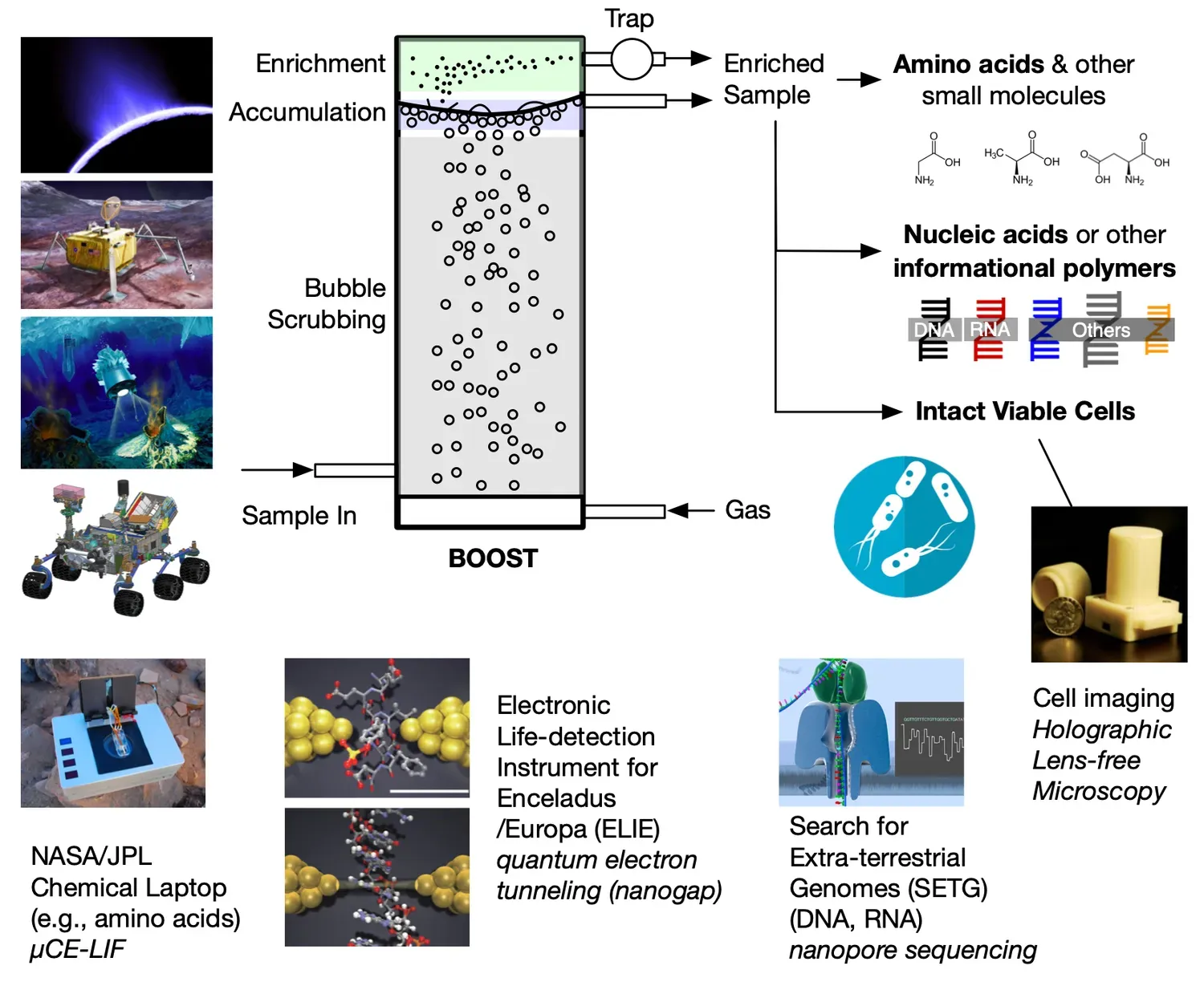
Bubble-based Ocean-worlds Organics Sample Trap
A bubble-based trap that concentrates organics and cells from ocean-world samples for life-detection instruments.
Background: Estimated energetic limits for life in Ocean Worlds such as Enceladus and Europa suggest that many current life-detection technologies will require pre-concentration of ice or liquid (brine, ocean) samples on the order of 1000× to facilitate detection.
Science goal: We set out to develop an organic concentrator, the Bubble-based Ocean-worlds Organics Sample Trap (BOOST), which could be used to process samples from a plume, ice, brine pocket, or liquid, such as from a subsurface ocean.
Objectives: (1) Conduct lab experiments to determine optimal system design. (2) Develop a prototype and evaluate performance on a set of Ocean World analogs. (3) Advance technology readiness level (TRL) from TRL 2 to TRL 4 and characterize steps required to advance BOOST, with further funding, to TRL 6.
Methodology: Our approach is inspired by observations that bubbles can scrub organic material from liquids, that organics concentrate in a sea-surface microlayer, and that bursting bubbles can generate enrichment of organic materials relative to the bulk aqueous phase. The project used lab experiments to study the impact of device and sample parameters on bubble size, lifetime, number, and other characteristics, and to relate these characteristics to enrichment of organics across a 1010 size range, from amino acids to whole cells.
Prior work demonstrates how tuning of parameters affects enrichment, and factors of 100 to 10,000 have previously been achieved. Temperature gradients can be used to move bubbles even in the absence of buoyancy (for example, in weightlessness), and can also be used to promote enrichment through bubble thinning and via convective flow.
These lab experiments were designed to optimize BOOST devices, with boundary conditions ranging from a millifluidic single-bubble device up to a device with a 1 L sample capacity. BOOST is anti-fouling because it achieves concentration without a physical filter, and it is amenable to batch or continuous-flow applications.
The project used both synthetic analogs, representing Ocean World end-members for Europa and Enceladus, and a range of relevant samples, such as NaCl, MgSO4, and MgCl2 brines from terrestrial analog environments studied in related work by Prof. Carr. The plan was to compare the ability to concentrate organics (amino acids, protein, nucleic acids, and whole cells) with other methods used to study these samples, and to demonstrate the expected limit of detection (LOD) improvements in full-scale life-detection tests.
Relevance: BOOST addresses a critical pathway to life detection for future Ocean Worlds missions (such as at Enceladus, Europa, Titan, or Mars, a relic Ocean World), as described in the Planetary Science Research Program and the NASA Science Plan. The project aimed to “substantially improve instrument measurement capabilities,” with “explicit comparisons to the current state-of-the-art,” and to bridge the gap between life-detection instrument LODs and the LODs required to detect life on Ocean Worlds missions.
Gallery