 Planetary eXploration Lab
Entero · Active
Entero
Enterococcus Evolution in Space: Environmental Adaptations, Antibiotic Resistance, and Clinical Implications (Entero)
How Enterococcus bacteria adapt and acquire antibiotic resistance aboard the International Space Station.
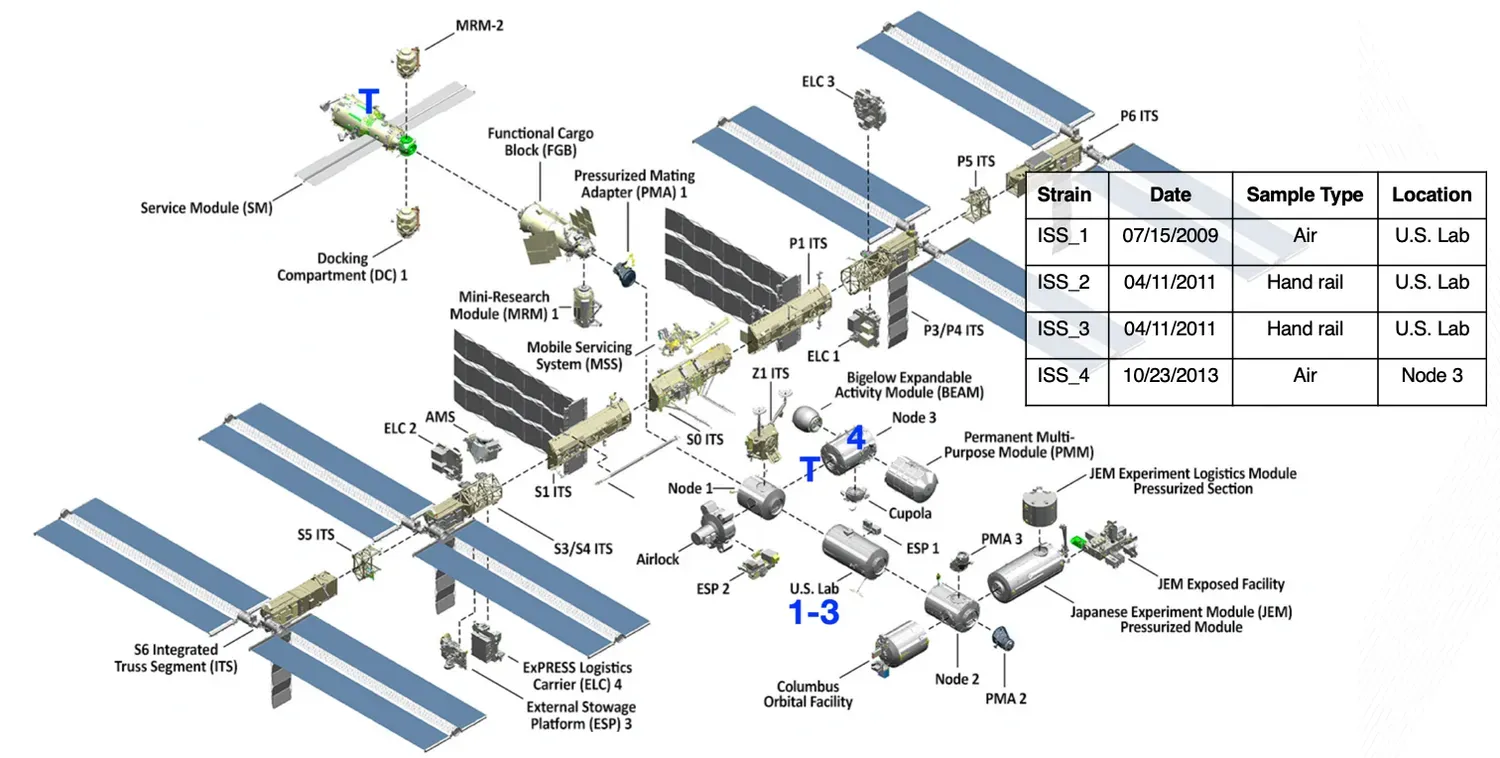
Enterococci are gram-positive bacteria that originated when our ancient animal ancestors emerged from the oceans to live on land and brought their gut flora with them. Enterococcus faecalis and Enterococcus faecium are common human commensals and harbor multidrug resistance. Both have been isolated on the ISS. Likely as a consequence of their evolutionary origins, enterococci show remarkable stress resistance within, but also outside, their human hosts. Their antibiotic resistance, coupled with tolerance to desiccation, starvation, and disinfection, makes them potent pathogens in the built environment and a risk to crew health during space missions.
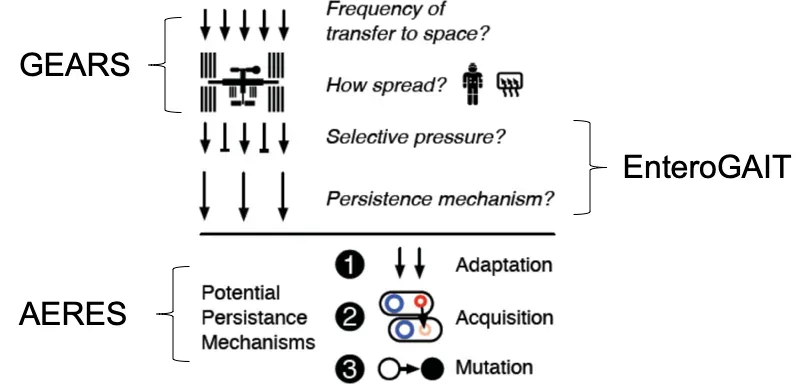
Aims: The project has three aims: (1) characterize the frequency and genomic identity of antibiotic-resistant organisms, including enterococci, on the ISS; (2) assess the evolutionary selective pressure of the space environment (microgravity and space radiation) using E. faecalis as a model system; and (3) characterize the natural evolutionary history of E. faecalis on Earth and in space, to reveal mechanisms of microbial adaptation and refine crew health risk assessment and countermeasures for future missions. Each aim has its own investigation.
GEARS: Led by co-principal investigators Aaron Burton and Sarah Wallace (NASA), this flight experiment uses existing ISS facilities to detect antibiotic-resistant microbes, identify them to species level by nanopore sequencing, and select isolates for return to Earth. It complements routine microbial monitoring by focusing on the clinically relevant subset of antibiotic-resistant microbes. Session 1 launched on SpaceX CRS-30 in March 2024; crew members collected samples and sequenced DNA in April and May 2024, the first metagenomic sequencing performed beyond Earth. Session 2, from late 2024 into early 2025, produced the first complete whole genomes and the first methylome generated in space. Session 3 launched on CRS-34 in May 2026, and the final session launched on CRS-35 in October 2026. Most colonies recovered so far are Staphylococcus species; E. faecalis is not widespread on the ISS. NASA’s GEARS investigation page, with video.
Enterococcus Growth Advantage on ISS via Tn-seq (EnteroGAIT): Led by co-principal investigator Michael Gilmore (MEEI), this flight experiment was designed to measure the selective pressure of the space environment on a library of E. faecalis mutants created by transposon insertional mutagenesis, using transposon sequencing (Tn-seq) with a synchronous ground control. The experiment passed its science verification tests in the flight hardware in July 2024. In the experiment verification test that followed in August 2024, the library grew poorly. We believe the cause was a three-week outage of chilled water during the test, which left the lab at about 32 °C (90 °F) and 69% relative humidity. NASA then directed the team to focus on GEARS and AERES, and EnteroGAIT did not fly.
Adaptation and Evolution of Resilient Enterococcus in Space (AERES): Led by Prof. Carr (Georgia Tech), this ground-based study sequences and assembles complete genomes of Earth- and space-derived enterococci with nanopore sequencing. It characterizes horizontal gene transfer, mutation, and implications for community-acquired infection in space and on Earth.
Significance and relevance: The work improves understanding of microbial adaptation to the space environment and of risks to crew health. Because the ISS is a built environment much like a hospital, the findings also bear on antibiotic resistance and hospital-acquired infections on Earth. The project addresses the 2011 Decadal Survey recommendation to use the ISS as a microbial observatory and several gaps in NASA’s Human Research Roadmap.
Lab publications
- , . Validation of Gentamicin and Streptomycin Stability for On-Orbit Microbial Monitoring. Gravit Space Res. 2026 Jul 7;14(1):43–52. doi: 10.2478/gsr-2026-0003.
- , , , , , . Genomic and functional characterization of Enterococcus faecalis isolates recovered from the International Space Station and their potential for pathogenicity. Front Microbiol. 2021 Jan 11;11:515319. doi: 10.3389/fmicb.2020.515319. PMID: 33505359. PMCID: PMC7829349.
Presentations and abstracts
- , , , , , , , , , , , , . Genomic Enumeration of Antibiotic Resistance in Space (GEARS). One Health in Action: Winnable Strategies to Address Emerging Threats—Integrating Food, Animals, and the Environment through Microbial Genomics, Meru University of Science and Technology (MUST), Kenya. 2026 Jun.
- , , , , , , , , , , , , . Enterococci Evolution in Space: Environmental Adaptations, Antibiotic Resistance, and Clinical Implications. NASA Human Research Program (HRP) Investigators’ Workshop. 2026 Apr.
- , , , , , , , , , , , , . First Results from the Genomic Enumeration of Antibiotic Resistance in Space (GEARS) Flight Study. American Society for Gravitational and Space Research (ASGSR) Annual Conference, Phoenix, AZ. 2025 Dec.
- . Enabling the Genomic Enumeration of Antibiotic Resistance in Space (GEARS). Congress on the Prevention of Antimicrobial Resistance and Infection Control of Santa MAria (PRISMA), Lisbon, Portugal. 2025 Feb.
- , , , , , , , , . Operational Control for Enterococci ANtibiotic resistance in Space (OCEANS): An ISS Analog Study. ASGSR Annual Meeting, San Juan, Puerto Rico. 2024 Dec.
- , , , , , , , , , , , , . Enabling Genomic Enumeration of Antibiotic Resistance in Space (GEARS). American Society for Gravitational and Space Research (ASGSR) Conference, Washington DC. 2023 Nov.
- , , , , , , , , , , . Validation of antibiotic stability for on-orbit microbial monitoring. American Society for Gravitational and Space Research (ASGSR), 38th Annual Meeting, Houston, Texas, USA. 2022 Nov.
- , , , , , , , , . Enterococci in Space: Adaptation, Antibiotic Resistance, and Clinical Implications. American Society for Gravitational and Space Research (ASGSR) Conference, Baltimore, Maryland. 2021 Nov.
- , , , , , . Characterization of E. faecalis isolated from the ISS and the genes required for survival in the space radiation environment. 35th Annual Meeting for the American Society for Gravitational and Space Research (ASGSR), Denver, CO. 2019 Nov.
- , , , , , . Characterization of E. faecalis isolated from the ISS and the genes required for survival in the space radiation environment. Astrobiology Science Conference. 2019 Jun.
- , , , , . Genomic and functional characterization of desiccation tolerance in E. faecalis. 5th International Conference on Enterococci, Chamonix, France. 2018 Apr.
Gallery