 Planetary eXploration Lab
SETG · Completed
SETG
Search for Extra-Terrestrial Genomes
Nanopore DNA and RNA sequencing instruments to search for life on Mars and other worlds.
High school interns: Jonathan Borowsky
Staff: Julie Hachey, Kendall Saboda
Postdocs: Alexandra Pontefract, Jacopo Tani
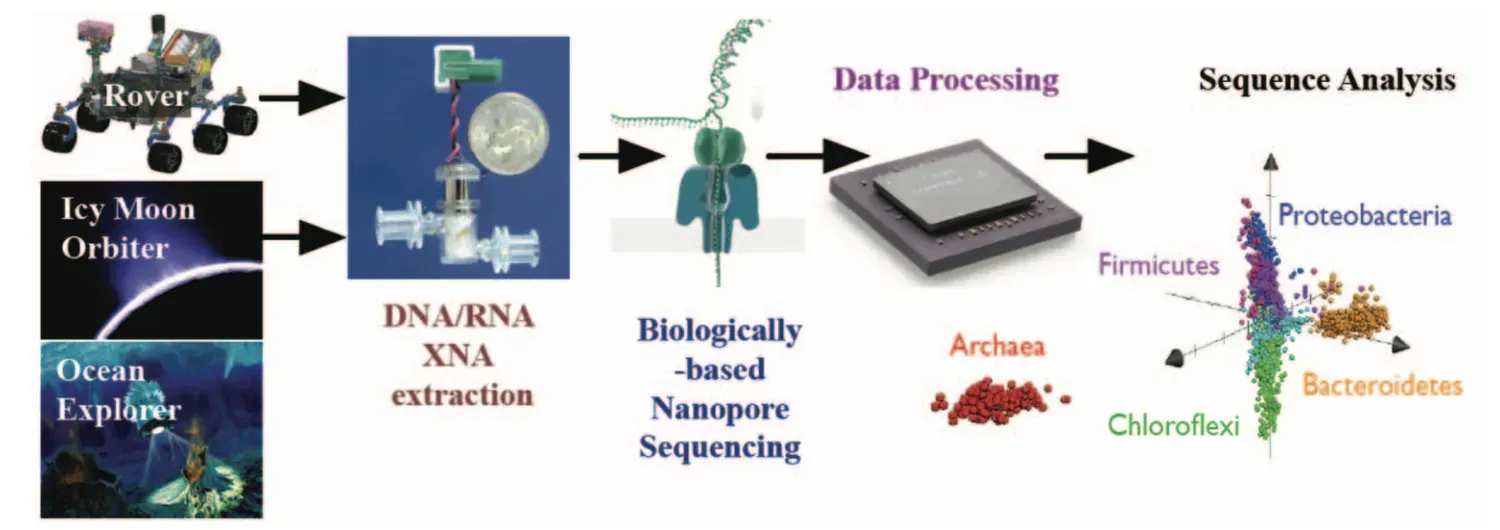
The Search for Extra-Terrestrial Genomes (SETG) will search for nucleic acid-based life beyond Earth using single-molecule sequencing. Our Maturation of Instruments for Solar System Exploration (MatISSE) effort focused on developing an integrated instrument from technology readiness level (TRL) 3 to TRL 6 (sample in/sequence out under simulated Mars temperature/pressure) and assessing the limit of detection (LOD). We were able to advance component and/or subsystem TRLs as high as 6 in some cases and achieved an overall TRL of 4 and partway to TRL 5; therefore, the current system TRL stands at TRL 4. At Georgia Tech, work continues on the next phase of SETG. This payload, Biological Exploration Payload 2 (BioX2), integrated many aspects of SETG into an automated payload that launched to the International Space Station (ISS) in November 2022. BioX2 was designed to elevate the TRL level of several key components and subsystems in preparation for future flight definition, for example as a CubeSat demonstrator, and ultimately as part of an in-situ life detection mission. Key accomplishments and outcomes:
Enabled training of 17 students and/or staff and supported transition to tenure track or research faculty positions for three project members.
Supported 15 refereed conference or journal papers, indicated in bold as P1 to P15 as listed in the Publications section.
Synthesized Mars analog regolith samples doped with B. subtilis spores (P4) and validated a wide range of counting methods, identifying viable spore assay and/or Tunable Resistive Pulse Sensing (TRPS) as gold standards for quantifying spore titer.
Validated extraction procedure to meet requirements of 5% extraction yield (DNA out/DNA in) across all analog samples (P4, P12).
Developed procedure to count individual genomes using digital droplet polymerase chain reaction (PCR) to facilitate evaluation of extraction efficiency at low biomass (P12).
Evaluated two single-molecule nanopore sequencing technologies and advanced strand sequencing (MinION) sequencing capabilities by:
detecting non-standard astrobiologically relevant inosine bases (P3),
demonstrating a limit of detection of ~1 ppb for SETG using 2 picograms of DNA, orders of magnitude below the nominal input DNA requirement, by developing CarrierSeq (P6),
demonstrating a negligible false positive rate (P7),
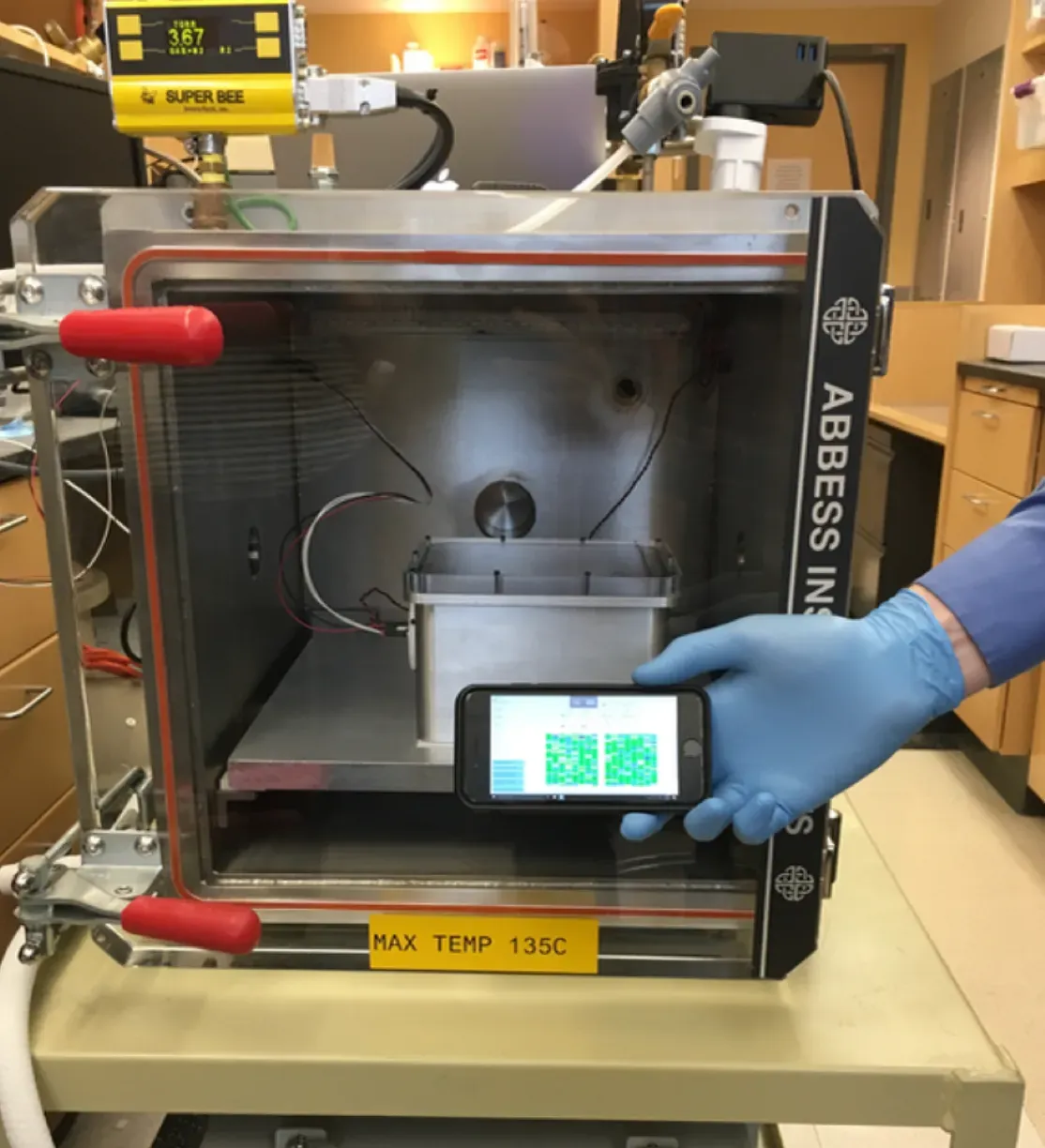
performing sequencing under Mars-like conditions (P11), and
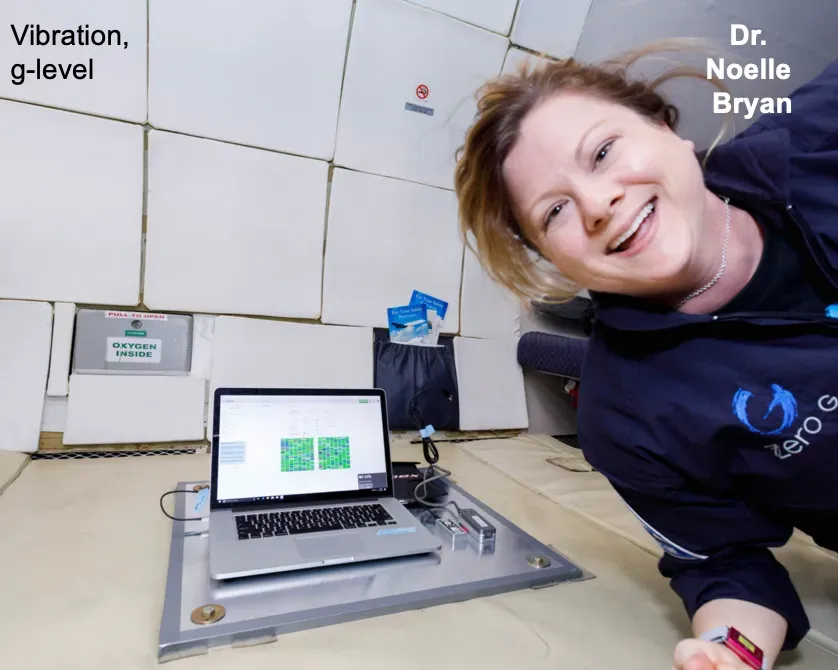
demonstrating robustness of nanopore sequencing to vibration and g-level (P13).
Automated nucleic acid extraction and demonstrated a TRL 4 system through sample to sequence with limited manual handling (P3).
Developed a pre-TRL 5 testbed that facilitated risk reduction activities and demonstrated automation of all critical SETG steps (P10).
Designed and partially implemented a TRL 5 SETG system.
Deployed one no-cost payload to the ISS to validate SETG reagents (BioX1).
Designed a second payload that will validate SETG hardware designs and advance SETG TRL through on-orbit operation (BioX2).
Addendum: Exploring Mars on Earth
To study the limits of life and to test instrumentation, we have carried out fieldwork at terrestrial analogs of Mars. Examples include:
Volcán Copahue, Argentina, an active volcano with acidic iron-rich hydrothermal streams.
Haughton Impact Structure, Devon Island, Nunavut, Canada, a 20+ million-year-old impact crater in a polar desert with low mean annual temperatures.
Spotted Lake, Canada, a hypersaline, magnesium sulfate-rich analog for paleolakes on ancient Mars.
Other significant contributions to date include:
Ultra-portable nanopore sequencing (<200 grams).
Use of space radiation analogs to demonstrate robustness of biological reagents and sequencing chips.
Lab publications
- , , , , , . Nanopore Sequencing at Mars, Europa, and Microgravity Conditions. NPJ Microgravity. 2020;6(1):24. doi: 10.1038/s41526-020-00113-9. PMID: 32964110. PMCID: PMC7477557.Data 1: osf.ioCode: github.comData 2: osf.io
- , , , , , , , . Nucleic Acid Extraction and Sequencing from Low-Biomass Synthetic Mars Analog Soils for In Situ Life Detection. Astrobiology. 2019 Sep;19(9):1139–1152. doi: 10.1089/ast.2018.1929. PMID: 31204862. PMCID: PMC6708270.
- , , , , , , . Development of a Nucleic Acid-Based Life Detection Instrument Testbed. IEEE Aerospace Conference. 2019 Mar;(Paper 2181):1–10. doi: 10.1109/AERO.2019.8742193.
- , , . Enabling Measurement of Darwinian Evolution in Space. IEEE Aerospace Conference. 2019 Mar;(Paper 2077):1–10. doi: 10.1109/AERO.2019.8742164.
- , , , , , , . Nucleic Acid Sequencing Under Mars-Like Conditions. IEEE Aerospace Conference. 2019 Mar;(Paper 2860):1–7. doi: 10.1109/AERO.2019.8741543.
- , , , , . Sequencing Nothing: Exploring Failure Modes of Nanopore Sensing and Implications for Life Detection. Life Sci Space Res (Amst). 2018 Aug;18:80–86. doi: 10.1016/j.lssr.2018.05.004. PMID: 30100151.
- , , , , . CarrierSeq: a sequence analysis workflow for low-input nanopore sequencing. BMC Bioinformatics. 2018 Mar 27;19(1):108. doi: 10.1186/s12859-018-2124-3. PMID: 29587645. PMCID: PMC5872496.Code: github.comData: 10.6084/m9.figshare.5471824.v1
- , , , , , . Acceleration Profiles and Processing Methods for Parabolic Flight. NPJ Microgravity. 2018;4:14. doi: 10.1038/s41526-018-0050-3. PMID: 30109261. PMCID: PMC6081456. arXiv: 1712.05737.Code: github.comData: osf.io
- , , , , , , , . Microbial diversity in a hypersaline sulfate lake: a terrestrial analog of ancient Mars. Front Microbiol. 2017 Sep 26;8:1819. doi: 10.3389/fmicb.2017.01819. PMID: 29018418. PMCID: PMC5623196.
- , , , . Nucleic acid extraction from synthetic Mars analog soils for in situ life detection. Astrobiology. 2017 Jul;17(8):747–760. doi: 10.1089/ast.2016.1535. PMID: 28704064. PMCID: PMC5567878.
- , , . Cold Testing of Conductive Bridging Random Access Memory for Space Applications. IEEE Aerospace Conference. 2017 Mar;(Paper 2250):1–10. doi: 10.1109/AERO.2017.7943828.
- , , , , , , , , , , , , . Advancing the Search for Extra-Terrestrial Genomes. IEEE Aerospace Conference. 2016 Mar;1–15. doi: 10.1109/AERO.2016.7500859.
- , , , , . SETG: An instrument for detection of life on Mars ancestrally related to life on Earth. IEEE Aerospace Conference. 2011 Apr;1–12. doi: 10.1109/AERO.2011.5747299.
Presentations and abstracts
- . Resolving the History of Life on Earth by Seeking Life As We Know It on Mars. Morehouse STEM Seminar, Department of Physics, Morehouse College. 2024 Apr.
- , , , , , , . A Direct Search for Life As We Know It and Don’t Know It. 23rd SANKEN International Symposium, Awaji, Japan; and 2020 ExplOrigins Colloquium, Georgia Institute of Technology (January 28, 2020). 2020 Jan.
- , , , . Detecting Darwinian Evolution via Nanopore Sequencing. Astrobiology Science Conference. 2019 Jun.
- , , , , , . Nanopore Sequencing at Mars, Europa, and Microgravity Conditions. Astrobiology Science Conference. 2019 Jun.
- , , . The Search for Extra-Terrestrial Genomes (SETG). Wentworth Institute of Technology, Innovation and Entrepreneurship Center (Accelerate). 2019 Jan.
- . Towards In-Situ Detection of Informational Polymers for Life Detection on Ocean Worlds. Astrobiology Science Conference. 2019.
- , , , , , , . Informational polymers as unambiguous biomarkers for aqueous-based life. European Astrobiology Network Association (EANA), Berlin, Germany. 2018 Sep.
- . The Limits of Life. Gary 66 Symposium, Boston, MA. 2018 Jun.
- , , , . Needs and Technologies to Enable the Direct Search for Life Beyond Earth. Technologies and Infrastructures Workshop for Planetary Exploration, Horizon 2061, EPFL. 2018 Apr.
- , , . Single Molecule Sensing and Sequencing for Life Detection Beyond Earth. Astrobiology Science Strategy for the Search for Life in the Universe, National Academies of Sciences, Engineering, and Medicine, Washington DC. 2018 Apr.
- , , , , , . DNA Sequencing During Simulated Mars, Europa, and Zero Gravity. MIT Media Lab Zero Gravity Flight Research Symposium (Jan 23, 2018) & MIT Media Lab Beyond the Cradle 2018 (Mar 14, 2018). 2018 Jan.
- . Opportunities and Challenges for Life Detection via 'Omics' Approaches. ELSI/EON International Workshop on Life Detection, Earth Life Science Institute (ELSI), Tokyo Institute of Technology, Japan. 2017 Oct.
- . On the Search for Informational Polymers Beyond Earth. Earth Life Science Institute, Tokyo Institute of Technology, Japan. 2017 Aug.
- . Towards In Situ Sequencing for Life Detection. Future In-Space Operations (FISO) Telecon, University of Texas. 2017 May. spirit.as.utexas.edu
- , , , , , , , . Progress and Challenges for Life Detection via Nucleic Acid Sequencing. Astrobiology Science Conference, Mesa, Arizona. 2017 Apr;(Abstract 3395).
- , , , , , , , . Nucleic Acid Extraction and Sequencing from Low-Biomass Synthetic Mars Analog Soils. Lunar & Planetary Sci XLVIII, The Woodlands, Texas. 2017 Mar;(Abstract 1585).
- , , , , , , , , , . Understanding Habitability and Biosignature Preservation in a Hypersaline Mars Analog Environment: Lessons from Spotted Lake. Lunar and Planetary Science XLVIII (2017). 2017 Mar;(Abstract 1124). hou.usra.edu
- , , , . On Neuromorphic Architectures for Efficient, Robust, and Adaptable Autonomy in Life Detection and Other Deep Space Missions. Planetary Science Vision 2050 Workshop, Washington, DC. 2017 Feb;(Abstract 8080).
- , , , , , , , , , . Single Molecule Sequencing for Life Detection Beyond Earth. Nanopore Community Meeting, New York, NY. 2016 Dec. Video: nanoporetech.com
- , , , , , , , , , , . SETG: Nucleic Acid Extraction and Sequencing for In Situ Life Detection on Mars. 3rd International Workshop on Instrumentation for Planetary Missions. Pasadena, CA. 2016 Oct;(Abstract 4095).
- , , , , , , , . Single molecule sequencing and the search for life beyond Earth. Cold Spring Harbor Asia, Microbiology and the Environment, Suzhou, China. 2016 Sep.
- , , , . The Search for Extra-Terrestrial Genomes. Biosignatures and the Search for Life on Mars, Iceland. 2016 Jul.
- , , , . Methods for Extracting Nucleic Acids from Mars Analog Regolith. Lunar & Planetary Sci XLVII, The Woodlands, Texas. 2016 Mar;(Abstract 1643).
- , , , . The Search for Extra-Terrestrial Genomes: Nucleic Acid Extraction from Mars Analog Soils. Northeastern Geobiology Symposium, Poster. 2016.
- , , , , , , . The Search for Unambiguous Biosignatures: DNA Extraction and Sequencing in Mars Analogue Environments. Northeastern Geobiology Symposium. 2016.
- , , , . Human Exploration of Mars at Valles Marineris: The Past, Present, and Future of Life on Mars. First Landing Site/Exploration Zone Workshop for Human Missions to the Surface of Mars, Houston, TX. 2015 Oct;(Abstract 1036). hou.usra.edu
- . The Search for Extra-Terrestrial Genomes. LSU Dept. of Biology. 2014 Sep.
- . The Search for Extra-Terrestrial Genomes in Space Radiation – From Simulation to Survival. 13th Int’l Workshop on Radiation Damage to DNA, Cambridge, MA. 2014 Jun.
- . The Search for Extra-Terrestrial Genomes. Worcester Polytechnic Institute, Biomedical Engineering Seminar. 2012 Jan.
- . The Search for Extra-Terrestrial Genomes. MIT Lincoln Lab, Office of the Director Seminar Series. 2011 Sep.
- . The Search for Extra-Terrestrial Genomes: A life detection instrument with biological components. Synthetic biology workshop, NASA Ames Research Center. 2010 Oct.
Team publications
- Mojarro A, Jin L, Szostak JW, Head JW, Zuber MT. In search of the RNA world on Mars. Geobiology. 2021;19(3):307–321. doi: 10.1111/gbi.12433.
Gallery